EpiNexus is a web platform for analysing epigenomic sequencing data —
ChIP-seq, CUT&Tag, CUT&RUN, ATAC-seq and DNA methylation. Run
publication-ready analyses, from raw reads to super-enhancer maps, without
writing a single line of code: upload your files, click run, get results.
Drag and drop your FASTQ or BAM files in the browser, or import public data straight from GEO, SRA or ENA.
ChIP-seq, CUT&Tag, CUT&RUN, ATAC-seq, DNA methylation
FASTQ.gz, or BAM with its peak files
Choose your reference genome
2
Click Run
EpiNexus runs a full pipeline — QC, mapping, peak calling, annotation, differential analysis, and more.
Quality control & read mapping
Peak calling & annotation
Differential & super-enhancers
3
Explore Results
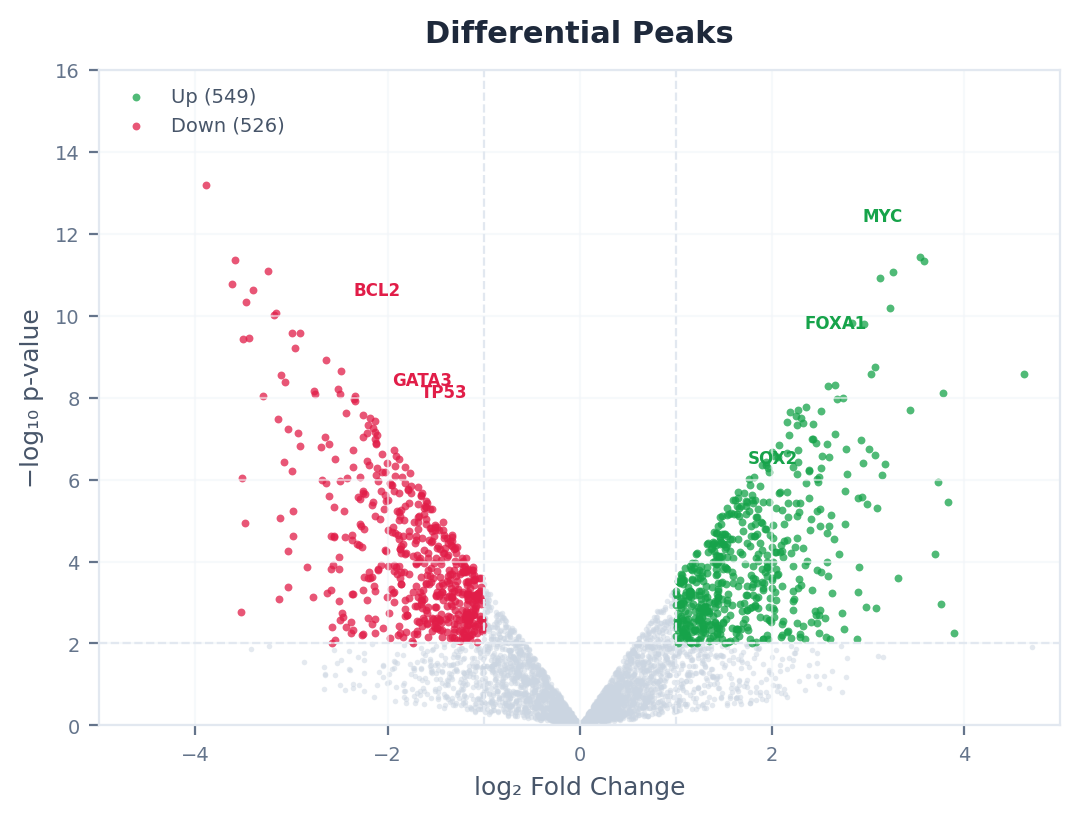
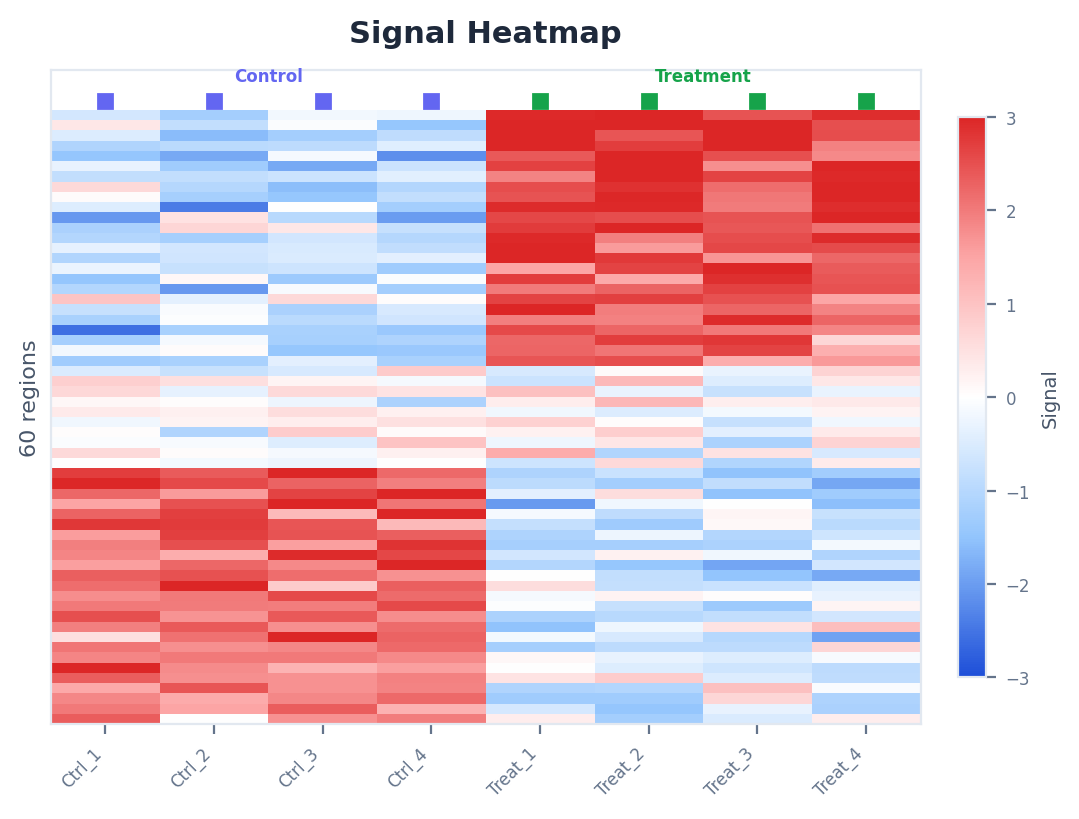
Interactive volcano plots, heatmaps, super-enhancer rankings — ready for your paper.
5Assay Types
End-to-EndOne Platform, Full Pipeline
10+Interactive Plots
Publication-ReadyFigures & Tables
Built for Epigenomics
Modules for histone marks, transcription factors, chromatin accessibility and DNA methylation, from QC to public reference data.
Peak Calling & Annotation
Automatically detect enriched regions in your data and see which genes and genomic features they overlap — promoters, exons, introns, and distal regions.
Histone Mark Analysis
Analyse H3K27ac, H3K27me3, H3K4me1, and other marks side by side. Each mark is called with the right peak shape — narrow or broad — and input or IgG controls are used as background.
Super-Enhancer Detection
Identify the large, highly active regulatory regions that drive cell identity. EpiNexus runs the ROSE algorithm on H3K27ac, MED1 or BRD4 data and highlights your top-ranked super-enhancers.
Quality Control
See at once whether your data is good. Each metric is graded against published standards (ENCODE and others) for the kind of sample — Good, Marginal, Below minimum or Fail — with plain advice for each value outside its range.
Multi-Mark Integration
Compare how H3K27ac and H3K27me3 change between conditions at each gene's promoter, in one run. Genes are grouped by what both marks did — for example H3K27ac gained and H3K27me3 lost — with nearby regions shown beside.
Differential Analysis
Compare conditions (e.g. treated vs. untreated) to find peaks that gain or lose signal, with DESeq2 statistics (csaw for broad marks), interactive volcano plots and downloadable tables.
Regulatory Atlas
See where your changed regions sit in public chromatin data: ENCODE's regulatory elements and chromatin states of hundreds of human and mouse reference samples, from many tissues. EpiNexus also checks that each sample looks like the tissue you say it is.
Motifs & Gene Ontology
Find the transcription-factor motifs and biological processes enriched in your peaks and in the regions that gained or lost signal, with JASPAR 2024 motifs and GREAT-style Gene Ontology.
Reproducible Reports
Every run records its software, settings, commands and reference data. Download a report with a methods section, a GEO submission package, or run the analysis again with one click.