Epigenomics Data Analysis with EpiNexus
From reads to biology, without code
Preface
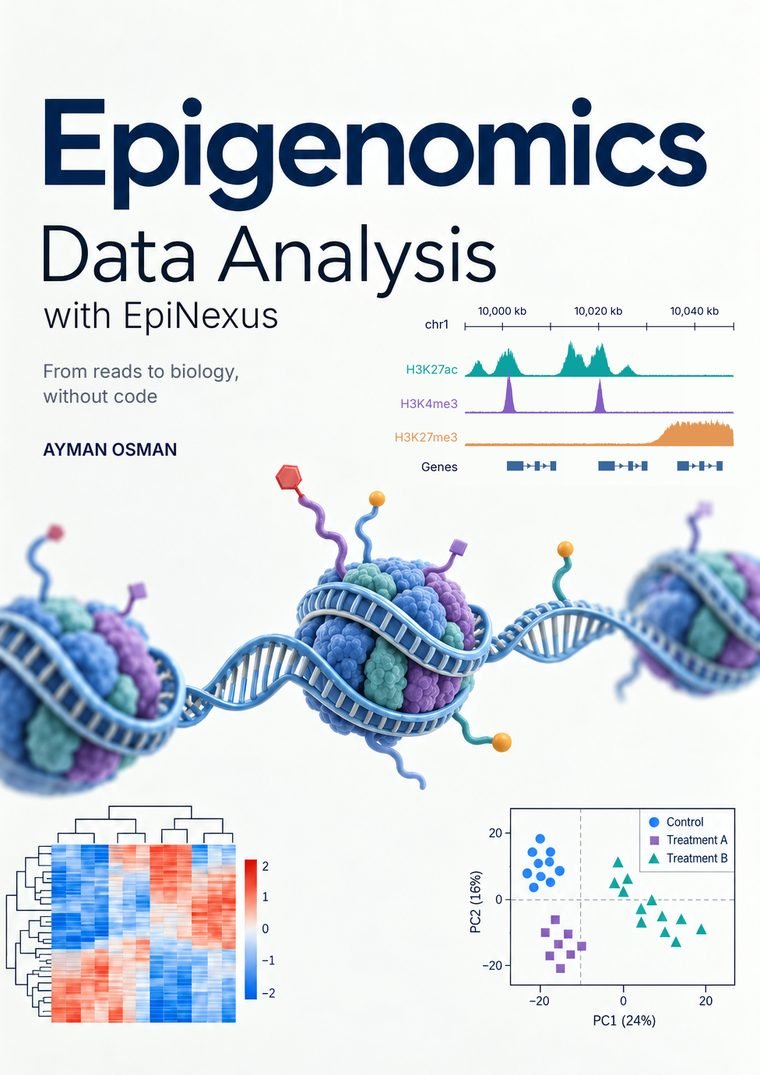
Many labs now profile chromatin as a routine experiment. A lab may run CUT&Tag on a few samples in a week, add ATAC-seq to see which regions open, and send bisulfite libraries to the sequencing core. Sequencing is easy. The analysis is often not.
The methods to analyse these data exist and work well. But the knowledge of how to use them is spread out. It is in consortium guidelines, in the code of analysis pipelines, in tool manuals, and in the methods sections of many papers. Many researchers get a table of “differential peaks” but cannot say why it has 900 regions and not 3,000, or if it should.
This book fills that gap. It explains, step by step, how to analyse epigenomic sequencing data. For each step, it explains what experts recommend and why, and how to read the result. Every chapter follows the same plan:
- the question the step answers;
- how the step works;
- what the field does, with the sources;
- how to do the step;
- how to read a real result;
- what can go wrong.
Who this book is for
This book is for biologists who analyse their own ChIP-seq, CUT&RUN, CUT&Tag, ATAC-seq or DNA methylation data. It is also for staff of core facilities who help them, and for students. You do not need to know how to program. Bioinformaticians will also find it useful. They will find the reasons behind each default setting, the published thresholds and their sources, and the places where practice is based on judgement, not evidence.
The book does not cover lab protocols, single-cell methods or chromosome conformation (Hi-C). Good resources exist for each of them.
How we do the analyses
The hands-on parts use EpiNexus. EpiNexus is a web platform that runs these analyses without code. It aligns the reads, checks their quality against published standards, calls peaks, compares conditions, interprets the results, and writes reports for publication.
The methods are the field’s methods, not EpiNexus’s own. EpiNexus runs the same tools that published pipelines use, such as Bowtie2, MACS3, SEACR, DESeq2, csaw, Bismark, dmrseq and MEME. When a step follows a rule that no publication sets, this book says so.
The examples use public data, and the book shows the results EpiNexus gives. We also checked these results against the results the original authors published, to make sure our methods and pipelines work. That check is part of our own quality control, so the book does not repeat it.
I designed and built EpiNexus. This is a conflict of interest, and you should know it when you read this book. I have tried to make the book useful whatever software you use. Each method is explained from its sources. Published thresholds are kept apart from EpiNexus’s own choices. Results that did not turn out as hoped are shown, not hidden.
Versions
This is a draft edition (0.1, October 2026), written for EpiNexus 1.2.6. EpiNexus 1.2.7 grades quality control in a new way (6 Quality control you can trust); the next edition will follow it. A chapter on combining histone marks will follow in a later edition. Software changes faster than books. The steps that depend on the EpiNexus interface are short and show the version they describe. The methods change more slowly.
Licence
The text of this book is licensed under the Creative Commons Attribution 4.0 International licence (CC BY 4.0). You may share and adapt it for any purpose if you give credit. The EpiNexus name, the EpiNexus logo and the screenshots of the EpiNexus interface are not covered by this licence. Figures from other works keep their own terms, which are given in their captions.
Acknowledgements
The examples in this book use data that their authors shared in public archives. They also use open-source software written by many people. We cite their papers wherever we use their data and tools.