A free book on epigenomics data analysis
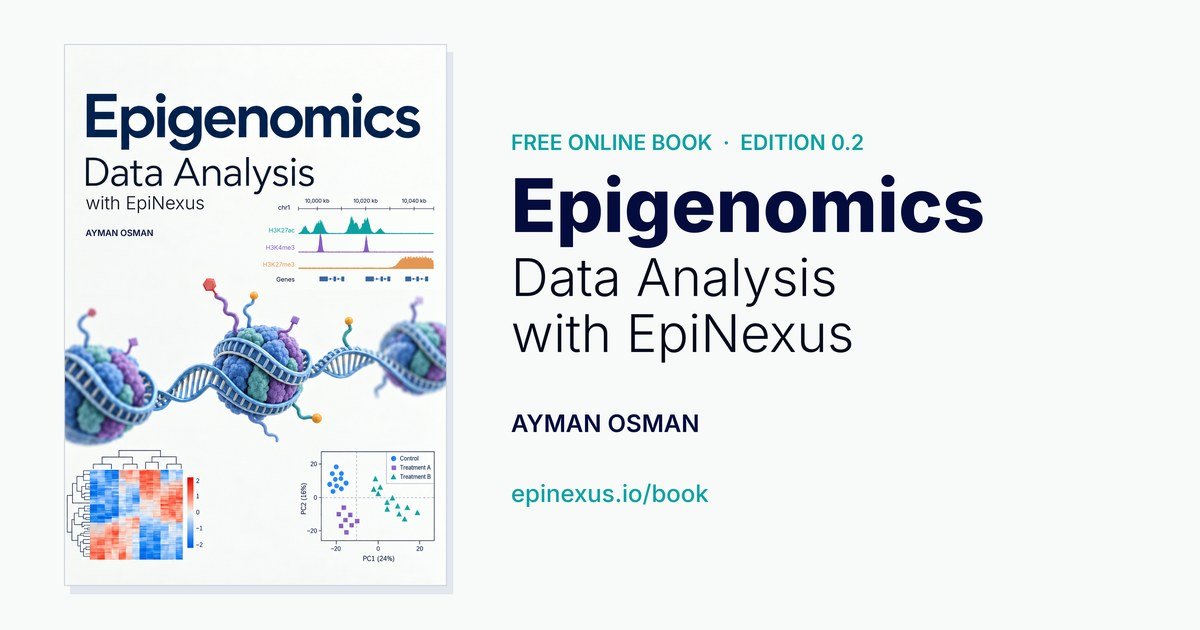
Many researchers who run ChIP-seq, CUT&RUN, CUT&Tag, ATAC-seq or DNA methylation experiments end up with a table of results they can't fully judge. Why did the analysis find 900 changed regions and not 3,000? Is this library good enough to keep? We have written a methods book that answers questions like these: Epigenomics Data Analysis with EpiNexus. It is free to read at epinexus.io/book, and the PDF of edition 0.2 is free to download from Zenodo, with a DOI you can cite.
Why we wrote it
The methods for analysing epigenomic data are well established, but the knowledge of how to use them is scattered. Part of it is in consortium standards such as ENCODE's, part in the code of analysis pipelines, part in tool manuals, and part in the methods sections of many papers. A biologist who wants to know why a step is done a certain way has to search all of them.
The book puts this knowledge in one place. For each step of an analysis it explains what the step does, what experts recommend and why, and how to read the result.
Who it is for
The book is for biologists who analyse their own data, for the staff of core facilities who help them, and for students. You don't need to know how to program. Bioinformaticians may find it useful too, because it gives the source of every published threshold and says where common practice rests on judgement rather than evidence.
The book doesn't cover lab protocols, single-cell methods or chromosome conformation (Hi-C).
What's inside
The book has 21 chapters in six parts, plus four appendices; the PDF has 214 pages.
- Foundations: what each assay measures, how to design an experiment you can analyse, and which data and reference files you need.
- From reads to peaks: read processing, quality control, peak calling and signal tracks.
- Comparing conditions: differential analysis and spike-in normalisation.
- From regions to biology: genes and pathways, motifs, enhancers, two histone marks read together, and your regions in public chromatin data.
- Case studies: one public dataset per assay, analysed from start to finish.
- Reporting: results that others can reproduce, and how to solve common problems.
The appendices hold a glossary, every quality-control threshold with its source, the supported genomes and the file formats.
Every chapter follows the same plan: the question the step answers, how it works, what the field does (with sources), how to do it, how to read a real result, and what can go wrong.
Real data, shown as it came out
Every example uses public data from NCBI GEO, analysed in EpiNexus, and the book shows the results as EpiNexus gave them, including those that didn't turn out as hoped. The case studies include:
- H3K27ac ChIP-seq in the mouse heart (GSE155100);
- CUT&Tag of H3K27me3 in mouse spermatogonia, with a fly spike-in (GSE221942);
- CUT&RUN of the transcription factor MafB in mouse macrophages (GSE287346);
- ATAC-seq after removal of SOX2 in mouse embryonic stem cells (GSE209527);
- RRBS of neurons lacking the enzymes Dnmt3a and Dnmt3b (GSE167954).
A note on independence
The book's author designed and built EpiNexus, and the book says so in its preface. The methods it teaches are the field's methods, not EpiNexus's own: EpiNexus runs the same tools as published pipelines, such as Bowtie2, MACS3, SEACR, DESeq2, csaw, Bismark, dmrseq and MEME. Published thresholds are kept apart from EpiNexus's own choices, and the book marks each of these choices.
Versions, and how to cite it
Edition 0.2 (October 2026) was written for EpiNexus 1.4.4. The steps that depend on the EpiNexus interface are kept short and name the version they describe, because software changes faster than methods. Each new edition gets its own DOI.
To cite the book:
Osman, A. (2026). Epigenomics Data Analysis with EpiNexus (edition 0.2). https://doi.org/10.5281/zenodo.23472249
You may use its figures and tables in lectures, courses and talks, with credit to the book.
Read the book online, or start with the chapter Quality control you can trust. EpiNexus itself is in an invite-only pilot: ask for access.
Sources
- Osman, A. (2026). Epigenomics Data Analysis with EpiNexus, edition 0.2. Zenodo. https://doi.org/10.5281/zenodo.23472249