How to Use
The guide to the app: create a project, upload your files or import public data, describe your samples, run an analysis and read the results. Every run setting is explained.
Open the guide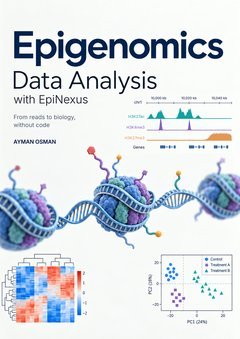
Free Book
Epigenomics Data Analysis with EpiNexus explains each step of an epigenomic analysis: what the step answers, what published standards recommend and why, and how to read a real result. Each step is shown on public data.
Free to read online. Edition 0.2, October 2026, written for EpiNexus 1.4.4. The PDF of this edition is free to download from Zenodo: doi.org/10.5281/zenodo.23472249.
Read the bookWhat the Book Covers
For biologists who analyse their own ChIP-seq, CUT&RUN, CUT&Tag, ATAC-seq or DNA methylation data. No programming needed.
Foundations
What each assay measures, how to design an experiment you can analyse, and which data and reference files you need.
From reads to peaks
A first analysis, read processing, quality control by published standards, peak calling and signal tracks.
Comparing conditions
Differential binding and accessibility, and spike-in normalisation for genome-wide changes.
From regions to biology
Annotation and Gene Ontology, motifs, super-enhancers, enhancer–gene links, and two histone marks read together, gene by gene.
Case studies
ChIP-seq, CUT&RUN and CUT&Tag, ATAC-seq and DNA methylation, each from public reads to biology.
Reporting
Results others can reproduce, methods text and GEO submission, and how to solve problems.